China Awaits Big Siberian Oil
The first stage of the ESPO pipeline was not yet put into operation when China and Russia began construction of the pipeline extension to Chinese Mohe. The age of European monopoly of pipelines from Russia is coming to an end.
Agreements with China are Signed, the First Seam is Welded
On May 18, the official ceremony marking the beginning of the construction of the delivery point from the Eastern Siberia - Pacific Ocean Oil Pipeline (ESPO) to the Chinese territory was carried out. The oil pipeline will extend for 992 km to the Chinese territory from the Russian boarder to Mohe city. The construction is expected to be completed by the end of 2010. Chinese companies will also be constructing the submerged crossing of the extension across the Amur River.
From the Russian side, the official ceremony marking the beginning of the construction of the extension from the ESPO to China took place on April 27 at the same time with the last “golden joint” welding of the first stage of the oil pipeline from Taishet to Skovorodino. During the ceremony of the completion of welding of the pipe RF Vice-Prime Minister Igor Sechin emphasized that construction of the ESPO would allow Russia to explore deposits that had been previously considered not efficient.
The path to the current touching friendship between Russia and China was rather crooked. According to the preliminary estimates (2001-2003) the oil pipeline for the export of the Eastern-Siberia oil was expected to go on route from Angarsk to Datsin, with China becoming the single consumer. Naturally, our eastern neighbor did everything possible and more to make sure that the project is implemented as soon as possible. It appears that the excessive activity of Chinese turned out against them, though according to some sources, Japan made a contribution. This overlapped with the Russia’s internal problems associated with YuKOS and the business was finished by making a decision to lay the pipeline up to the Pacific Ocean. China was to come to terms with the fact that it was getting only half of the Eastern-Siberia oil.
During his speech at the State Duma, on April 6, RF Prime Minister Vladimir Putin emphasized that “not everyone in the world is interested in new oil projects becoming reality, and Russia obtaining new opportunities for export”. The Prime Minister had good grounds for his statement. Even the open information demonstrates how the route of oil pipeline was tossed from southern to northern side of Baikal and by the end fled 400 km to the north, to the territory of permafrost and mountain chains that does nor appear a suitable place for the construction of the pipeline. It is most likely that the mass media never got all the information, and a serious undercover battle at the highest levels was led against the project as such, which is not surprising.
Control over the oil and gas deposits and the routes for transporting of the hydrocarbons is the key factor in the world’s politics. ESPO is qualitatively changing Russia’s capabilities for export supplies of oil that were previously Europe-destined. By 2014, when the second stage of the pipeline will be put into operation, Russia will obtain a unified oil pipeline system extending from the Pacific Ocean on the east to the Baltic and Black Sea on the west. The pipeline will carry 80 million tons of oil therefore the hypothetical shutdown of Mollukskiy strait for the tankers from the Middle East in the direction of the South-East Asia looses its apocalyptic meaning for the region.
Sacred Ecology
For the public opinion, the battle against ESPO appeared as a battle for environment. The outcome of the primary battle - for the safety of Lake Baikal, the World Natural Heritage site - was determined personally by Vladimir Putin as a President in the April of 2006. The oil pipeline was relocated to the north of the lake. At first beyond the watershed area and later after the designer did a little more thinking, it was moved 400 km to the north because the mountain chain immediately to the north of the lake is an area of catastrophic earthquakes and steep hills.
Strict adherence to the principle: safety of the oil pipeline for the environment - the primary factor for selection of the technology of construction and the route contributed to the successful completion of the first stage of the ESPO and approval of the second stage. Due to purely environmental arguments over 200 amendments were made to the route of the second stage of ESPO from Skovorodino to Kozmino oil port. The oil pipeline keeps clear of all the protected environmental territories including the nesting of the rare birds, the areas of growth of preserved plants, archeological sites and historical areas of unique interest. According to Transneft the new pipeline system is constructed with the best technology in design, construction and operation of the pipelines.
Primorye Governor’s Optimism Proves Valid
Five years ago, when the project for the construction of the pipeline to the Pacific Ocean was only discussed as an alternative to the approved route from Angarsk to Datsin, Sergei Darkin, the Governor of Primorye revealed surprising optimism and secured establishment of the Oil and Gas Institute at the Far Eastern State Technical University. This will be the first graduating year for its students. All 23 young specialists-engineers specializing in design, construction and operation of the gas - and oil pipelines and gas - and oil depots will be employed at the ESPO facilities and the facilities of the Sakhalin-Khabarovsk-Vladivostok oil pipeline.
The oil pipeline takes a more real share and the administrations of the regions where the pipe will traverse are busy compiling projects for the development of chemical and petrochemical production. These power consuming industries may rely on Sakhalin gas - gas pipeline from Sakhalin will go parallel to the oil pipeline throughout the Kahabrovsk-Vladivostok section. The decision is made for the construction of the Primorye Refinery 3-4 km from Kozmino oil port.
The oil pipeline is not operating yet, but the budget of Irkutskaya oblast received over 1 billion 204 million rubles during the 2006-2009. The budget of Nakhodka received over 100 million rubles of payroll taxes of the Kozmino port construction workers. When all the construction projects of the ESPO and Sakhalin-Khabarovsk-Vladivostok gas pipeline will be put into operation, the budgets of the Russian Far East regions will be replenished.
There Will Be Enough Oil
One of the top arguments against the construction of the ESPO and widely discussed in mass media during the past years and up to the moment is lack of oil for the operation of the oil pipeline with its estimated capacity. In early 2009, the Ministry of Natural Resources had to officially inform President Dmitriy Medvedev as well as others that hydrocarbon deposits with the potential for 1.8 billion tons were discovered within the construction area of the ESPO. According to Sergei Bogdanchikov, the Head of Rosneft Company which is the primary supplier of oil for the ESPO, its subdivisions are planning to launch the Vankorskoye Deposit in the Eastern Siberia in 2009; in 2012-2013 this region plans to launch Yurubcheno-Tokhmskoye deposit. Other Russian companies have already launched such large deposits in the Eastern Siberia as Talakanskoye and Verkhnechonskoye. Vankorskoye Deposit in the north of the Krasnoyaskiy Krai is one of the most promising in Russia. The explored oil reserves total 514.7 million tons, gas - 100 billion cubic meters. Rosneft estimates the extraction volumes at Vankor at up to 25 million tons annually.
It is estimated that by the 2015 up to 40 million tons of oil will be extracted throughout the Eastern Siberia and Yakutiya and by the 2025, the figures will increase to 80 million tons.
The World’s Most Lengthy Oil Pipeline…
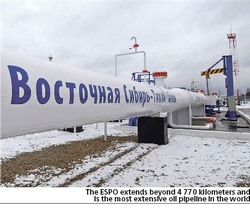
The ESPO extends beyond 4 770 kilometers and is the most extensive oil pipeline in the world. The first stage of the construction Taishet-Skovorodino (2757 km) began in April 2006 and will be put into operation by the end of 2009. The capacity of the first stage is 30 million tons. Of these, 15 million tons will be exported via the pipeline to China and 15 million tons via the railroad to the Kozmino oil port, were the first tanker will be shipped in December.
The second stage (second extension) of the ESPO project envisions construction of the oil pipeline from Skovorodino to the special marine oil port Kozmino with the total capacity of 50 million tons annually with the conjoined increase of the pipeline system’s carrying capacity of the Taishet-Skovorodino section up to 80 million tons annually. The total cost of the fist stage of the Eastern Siberia - Pacific Ocean oil pipeline amounts to approximately 420 billion rubles. Construction of the linear pipeline portion is valued at 320 billion rubles; another 69 billion rubles fall on special improvement of Kozmino. The remaining portion of the sum is spent on construction of the other facilities that are required for the operation of the pipeline.
…Will be Finalized on Chinese Money
The problems with the financing of the ESPO are primarily associated with the funding sources. It is not easy to find spare billions within the state budget or a private investor. China saved the project. The intergovernmental agreement for cooperation in oil sector between Russia and China was signed on April 21 in Beijing by the Russian Vice Prime Minister Igor Sechin and by Van Tsishan the Vice Prime Minister of the Chinese State Council. This agreement is signed for the period of 23 years and is a beginning of the fulfillment of loan agreements between the Transneft, Rosneft and Chinese Bank for Development for $ 25 billion as well as construction of the extension of the pipeline to China. Under these agreements Rosneft will receive a loan of $15 billion in exchange for supply of 15 million tons of oil annually to China. $ 10 billion of this loan will be allocated to Transneft for construction itself.
In summary, so far everyone is satisfied; each of the parties will obtain its dividends in the future in the form of oil or money from ESPO operation. This means that Russia, China, Japan, Korea and other Asian Pacific countries will be more closely economically connected with each other and less dependent on the situation in other parts of the planet. It is instructive to recall the words of Vladimir Putin - “not everyone in the world” is happy about it.